Why exterior paint fails early in Boca Raton, and why it is usually not the paint
Blistering on a stucco wall is almost always a water problem wearing a paint problem's clothes.
September 16, 2026 · 4 min read
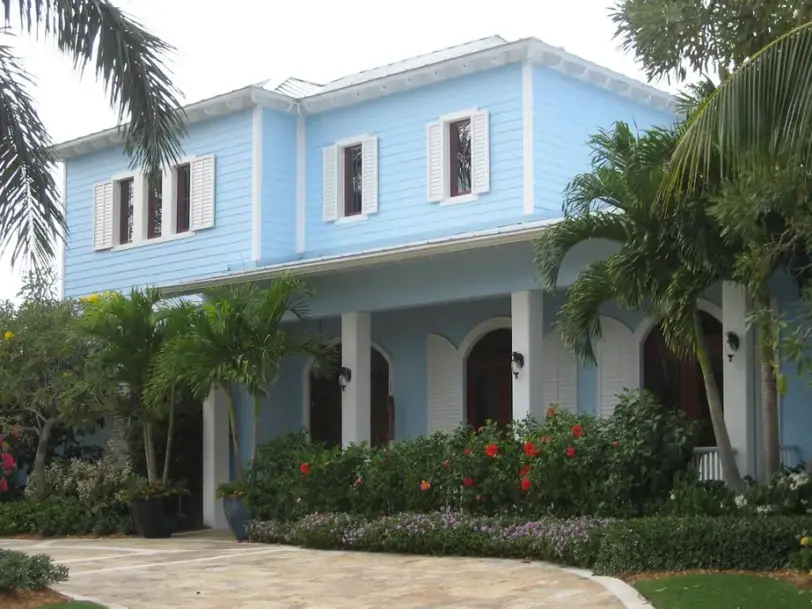
Every year we get called out to houses in Boca Raton where the owner opens with the same sentence: the paint failed. Sometimes they add that they used the expensive stuff, which makes it worse, because it means they already suspect they were sold something that did not work.
In almost every case the paint is the last thing in the chain that failed, not the first. It is simply the only part you can see.
What a coating is actually doing on a stucco wall
Paint on a stucco elevation is not a decorative skin. It is the part of the wall assembly that sheds water and takes the ultraviolet hit so the masonry underneath does not. It is doing that job on a coast where the sun does not let up for most of the year, where salt arrives on the sea breeze and sits on the surface, and where the rainy season delivers water sideways rather than straight down.
A coating can do that job for a long time. What it cannot do is hold back water that is already inside the wall. Water that gets in has to leave, and when it leaves it pushes the coating off from behind. That is what blistering and sheet peeling on stucco actually is. Not a cheap product. A wet wall under a film that could not dry fast enough.
Where the water is getting in
Three places, in roughly this order of likelihood.
- Hairline cracking in the stucco, most often stepping down and out from the corners of windows, where the wall is weakest and moves most. These are too fine to see from the driveway and wide enough to take water in a driven rain.
- Sealant at window perimeters, control joints and anywhere something penetrates the wall. Sealant has a shorter service life than the wall does. Once it has gone hard, shiny and shrunken away from one side of the joint, the joint is an open route in.
- Details above the wall. A blocked gutter or a failed flashing puts a concentrated volume of water down one stripe of an elevation, which is why failure so often shows up as a vertical band rather than evenly across the wall.
How to check your own house without a ladder
Wait until the sun is low and raking along the wall rather than hitting it face on. Crouch a bit and look along the plane of the stucco. Cracking that is invisible at midday shows up immediately in side light, because each crack casts a hairline shadow.
Then walk the windows. You are looking for sealant that has gone hard and glassy, or that has pulled away cleanly from one edge of the joint. Press it gently. Sound sealant is still slightly springy. Sealant at the end of its life feels like plastic.
Then put a flat hand on a wall that gets sun, and look at your palm. If it comes away chalky, the binder in the coating has broken down under ultraviolet and the surface is no longer shedding water properly. It is also why a chalked wall painted over without washing will shed the new coat within a couple of seasons: nothing bonds to dust.
Inside, the tells are a faint tide line low on a wall that shares a face with the outdoors, or paint lifting near a window return. Those are worth acting on early.
Why the order of work matters more than the product
The sequence that lasts is unglamorous. Wash the wall properly first, which removes chalk, salt and biological growth. Open out the cracks enough to take real material rather than skimming over them, patch, and texture the repair back so it does not sit as a smooth scar on a rough wall. Cut out and renew the failed sealant. Then the waterproofing coat. Then paint.
Skip the middle of that list and go straight to a topcoat and the house will look excellent for one season and start telling on you in the second. It is the cheapest job to sell and the most expensive one to own.
It is also worth saying plainly: the product on top is a smaller variable than most people expect. We work with Benjamin Moore, Sherwin-Williams and Centura Paints, and which one we reach for depends on the substrate and the exposure rather than a preference. A south facing stucco elevation and a shaded north wall are two different problems.
When to do something about it
Earlier than feels necessary, because the cost curve here is steep. A wall with fine cracking and tired sealant is a straightforward job. The same wall two rainy seasons later, after water has been moving through it, is a different conversation involving repairs that have nothing to do with painting.
If you want somebody to look along an elevation before it gets to that, call us on (954) 857-3213. We have been doing exteriors in Boca Raton and across Palm Beach and Broward counties since 1990, and we will tell you if what you have is a paint job or something else.
Creative Images Painting, Inc., (954) 857-3213
Call (954) 857-3213More articles
Painting a house you are still living in
The house still belongs to you while we are in it, and everything about the work has to bend around that.
Why painted kitchen cabinets go sticky, and what lacquer does differently
Cabinet doors are touched more than any other painted surface in a house, and a wall product cannot survive that.