03
Specialty Lacquer Finishes of Cabinetry and Built-ins
Kitchens, built-ins, panelling and entry doors. Millwork takes a different product, a different pace and a different room from a wall.
Chapter 01
Why brushed cabinet paint fails
Cabinet doors get touched more than any other painted surface in a house, and a wall product cannot survive that. Brushed on wall paint leaves brush marks that catch side light across a flat door panel. It stays soft for weeks, so a thumbnail prints into it. It builds unevenly at the stiles, so doors start to stick and then tear when somebody pulls them. And it never fully hardens, which is why kitchens painted this way go tacky around the handles within a year.
The underlying error is treating millwork as if it were a wall with hinges. A wall is seen from across a room. A cabinet door is seen from eighteen inches away, in kitchen light, by somebody who is already opening it.
Specialty lacquer finishes of cabinetry and built-ins is one of the ten services this company is licensed to carry out, and it is the one where the gap between a proper job and a cheap one is most visible.
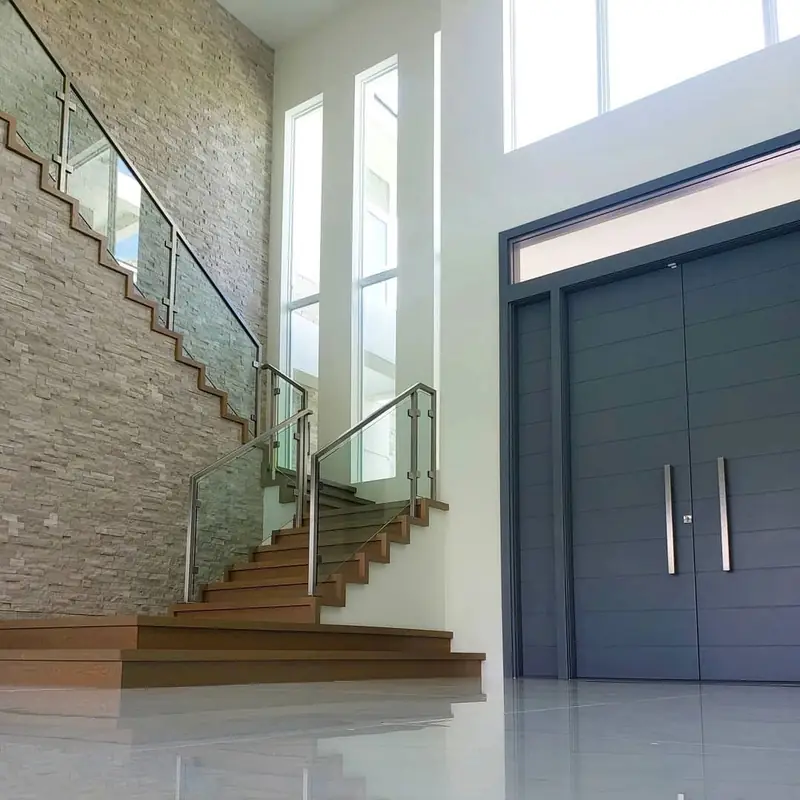
A stone-clad stairwell with a glass and steel railing beside dark modern double entry doors, finished by Creative Images Painting
What a proper lacquer job actually involves
Preparation is most of the work and none of the glamour. Kitchen millwork carries cooking grease, which no coating will bond through, so everything is degreased first and then de-glossed so the new finish has a mechanical key. Open grained species get grain filled if the finish is meant to read as smooth rather than as wood. Damage gets filled and sanded back flat, because lacquer is thin and hides nothing.
Doors and drawer fronts come off and get sprayed off the box, flat, in a controlled space, so the finish lays out without runs or brush texture. Hardware comes off and stays in labelled order, so a door that came off the second cabinet on the left goes back to the second cabinet on the left with its own hinges. The boxes get masked and sprayed in place. Between coats, everything is sanded.
It takes longer than painting a kitchen with a brush, and it is the only way to get a surface that still looks right after a few years of a family using it.
Chapter 03
Living with a lacquered kitchen
Dry and cured are not the same thing. A lacquer finish is dry to the touch quickly and continues hardening for a good while after that, so the first stretch calls for a little patience: no scrubbing, nothing heavy set down on a fresh surface, no adhesive shelf liner going straight onto a newly finished interior.
After that it is easy to look after. A damp cloth and a mild detergent is enough. What dulls a lacquered surface is abrasive cream cleaners and the scouring side of a sponge, which micro-scratch the sheen so the doors around the handles slowly go matt while the rest stays glossy. If something does chip, it is repairable, and it is far easier to repair in the first year than in the fifth.
We work out of Boca Raton and cover Palm Beach and Broward counties. If you want to talk through a kitchen or a set of built-ins, call (954) 857-3213.
Creative Images Painting, Boca Raton. Licensed and insured. Florida license # U-17482. Call (954) 857-3213.